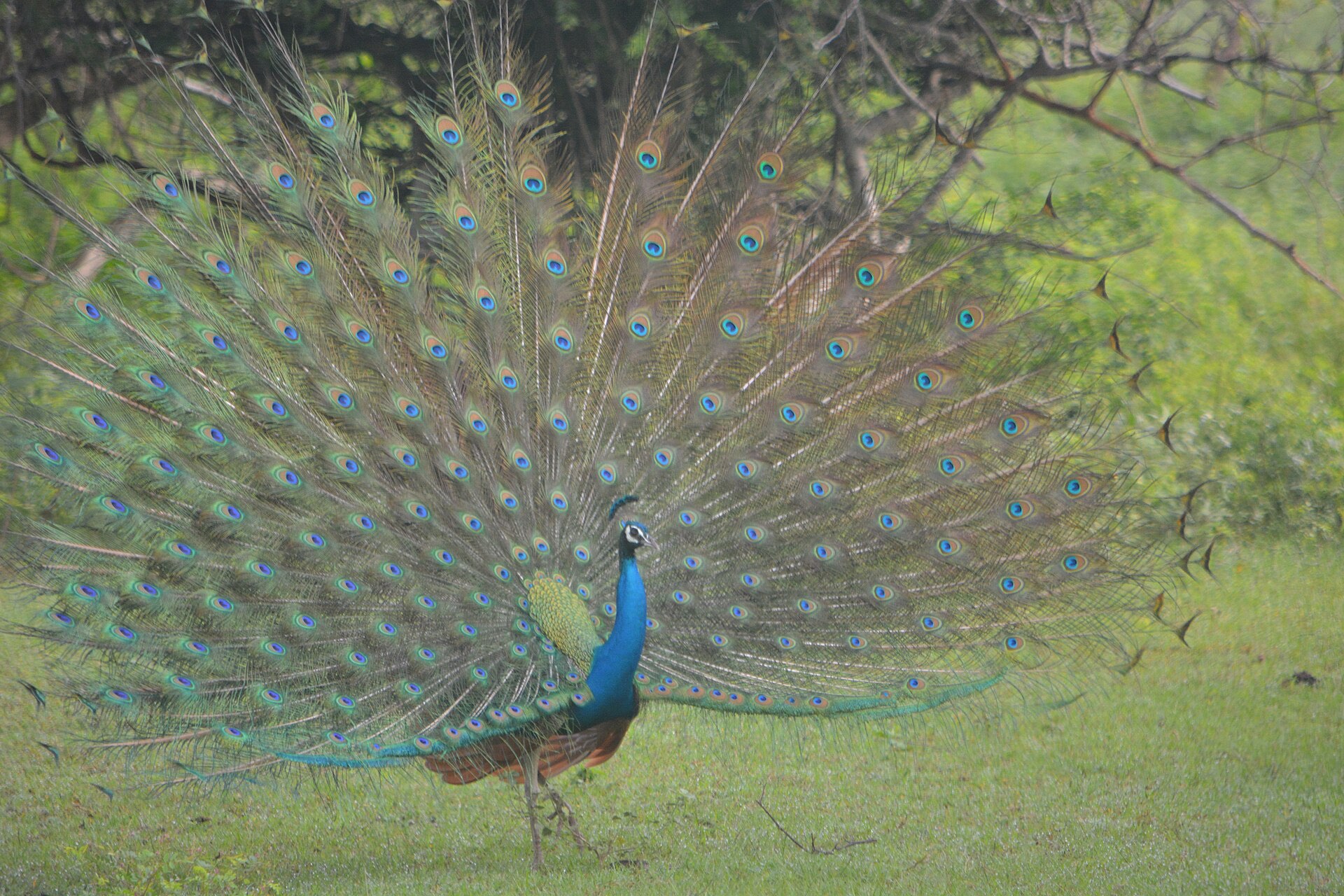
Indian peafowl
Pavo cristatusYala's most showy bird, and one of its most useful. Peafowl see leopards long before we do, and their loud alarm calls often lead trackers to a cat.
Indian peafowl displaying Pavo cristatus Kasun Illangasinghe · CC BY-SA 4.0
- Latin name
- Pavo cristatusIndian peafowl
- Status
- Least ConcernIUCN Red List
- Size
- Up to ~2.2 mmale, including the train
- Diet
- Seeds, insectslizards, even small snakes
- Where in Yala
- Everywhereopen scrub & roadsides
Overview
You'll see peafowl on every drive in Yala, and you'll hear them before you see them.
The male, the peacock, carries the famous train of long, eye-spotted feathers. It isn't his tail: it grows from his back, over the real tail. During courtship he raises it into a shimmering fan and rattles it to impress the females, the peahens, which are smaller and brown.
Peafowl spend the day feeding on the ground and fly up into tall trees to roost at night. They're sharp-eyed and nervous, and their loud, honking alarm call is one of the sounds our trackers listen for most closely, because it often means a leopard is on the move.
How to spot one.
Listen at dawn and dusk
Peafowl are loudest early and late in the day. Their call carries a long way across the scrub.
Follow the alarm
A sudden burst of alarm calls, with birds flying up into trees, is a classic sign that a leopard is nearby.
Look for displays
Males display in open clearings. Your tracker will stop if one is fanning its train near the road.
Check the treetops at sunset
Peafowl fly up to roost in tall trees in the evening, often in noisy groups.
At a glance.
- Active
- By day, roosting in trees at night
- Social life
- Small groups; males display to attract females
- Nest
- A shallow scrape on the ground
- The train
- Grows from the back, over the real tail
- Range
- Common across Sri Lanka's dry zone
- Spot it by
- Blue neck, crest, eye-spotted train
The best months.
Peafowl are resident all year and easy to see on any drive. Males carry their full trains for much of the year and shed them after the breeding season.
Three things to remember.
Not really a tail
The peacock's train is made of long back feathers. The short real tail sits underneath and helps lift the train.
A leopard alarm
Their honking alarm call is one of the most useful clues trackers have for finding a hidden cat.
Snake hunters
Peafowl eat insects, seeds and lizards, and will kill and eat small snakes.
How we watch them.
- We stop for displays but don't drive closer to flush birds into flight.
- No playing calls or noises to attract them.
- We give nesting hens on the ground plenty of space.
- Engines off near roosting trees at dusk.
More of Yala's wildlife.
The animals our guests ask about most, and how to find them.
Go looking for one. We know where.
Tell us your date and where you're staying. We'll confirm your jeep, your tracker and your pickup time, usually within a few hours.
- No deposit, pay after your safari
- Free cancellation up to 24 hours before
- Park tickets bought for you, no queue
Sunset over Yala Pramod Thilanka · CC BY-SA 4.0
Book a safari
We'll reply on email or WhatsApp, usually within a few hours.